Mahmudul Hossain
Google Ads & Conversion Tracking Specialist
6 October 26
7 min read
Illustration by Fsdm Mahmudul
People arrive on your website, look around, then leave without buying or contacting you. Before paying for more visitors, it helps to understand what stopped the people who already came.
Conversion rate optimisation, or CRO, is the work of finding those barriers and checking whether changes help more visitors complete a useful action. Our conversion rate optimisation service focuses on the journey from the first page visit to a sale or enquiry.
This beginner's guide explains what to measure, what to look for, and how to choose a sensible first improvement. You can start with one important page rather than changing your whole website.
A conversion is an action that matters to your business. For an online shop, it may be a completed purchase. For a local service, it may be a booking or a genuine enquiry.
Choose the main action before reviewing the page. Otherwise, a busier website can look successful even when the business gets little value from it.
Small actions can help explain the journey. A product view, a button click or a form start shows interest, but none proves that someone became a customer. Keep these supporting actions separate from completed purchases and enquiries.
A submitted form also needs a quality check. Spam and unsuitable requests should not be treated as useful leads. Your sales records help show which enquiries led to real conversations.
For a visitor-based rate, divide the visitors who completed your chosen action by the visitors measured, then multiply by 100. Use the same date range and counting rules for both groups.
Conversion rate = converting visitors ÷ total visitors × 100.
Some reports use sessions instead of visitors. A session is a visit, so one person can have several sessions. Label the measure clearly and keep the method consistent when comparing results.
Check that the action records only when it really happens. Opening a contact page is different from submitting a form. Pressing a payment button is different from completing a purchase. Duplicate records can also make performance look better than it is.
Compare like with like. Mobile visitors, returning customers and different traffic sources may behave differently. A change in the audience can move the overall rate even when the page stays the same.
SEO helps people find you through unpaid search results. Advertising pays to reach an audience. CRO examines what happens after people reach your website.
They work together. A clear page cannot solve every targeting problem, and well-targeted ads cannot repair a broken checkout. Review both the visitor's reason for arriving and the experience after arrival.
| Work | Main question | What to review |
|---|---|---|
| SEO | Can relevant people find us in search? | Search visibility and useful content |
| Advertising | Are we reaching suitable people? | Audience, search terms and ad promise |
| CRO | Can visitors understand and complete the next step? | Page message, trust, forms and checkout |
When an ad promises one service but opens a general page, visitors have to search again. A focused page should make the connection clear without asking people to guess.
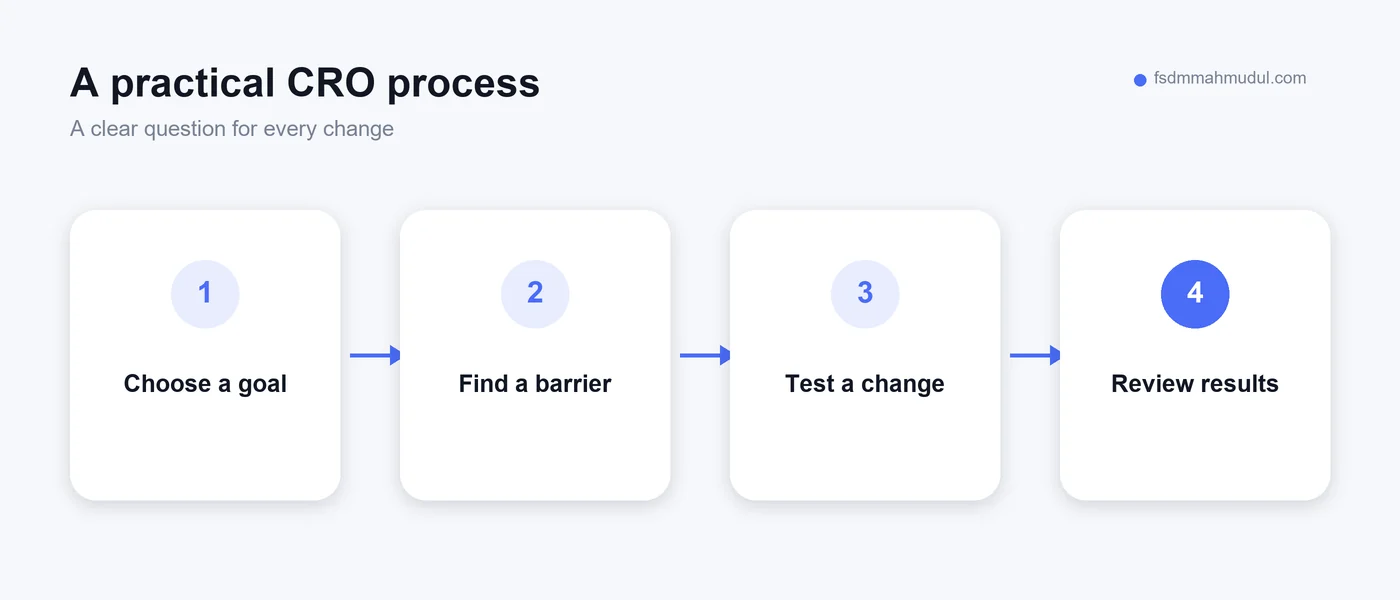
Walk through the journey as a new customer. Start from the link people actually use, then try to complete the main action on a phone.
Can someone quickly tell what you sell, who it is for and what to do next? A broad headline can leave the reader uncertain. Use plain words and explain the offer before asking for a commitment.
Customers may need delivery details, availability, service areas or an explanation of what happens after an enquiry. Put relevant answers near the decision they support. Use accurate information rather than promises the business cannot keep.
Look for cramped fields, unclear error messages, buttons covered by pop-ups and unexpected costs. Complete the form or checkout yourself. Reading a page is not enough to discover a problem that appears only during submission.
Use genuine reviews, clear contact details and relevant evidence. Explain what the customer will receive. Never invent testimonials, urgency or results to make the page seem more convincing.
Our CRO audit examples show the kind of page reviews we use to identify barriers. They are examples of our work, rather than a promise of what another business will achieve.
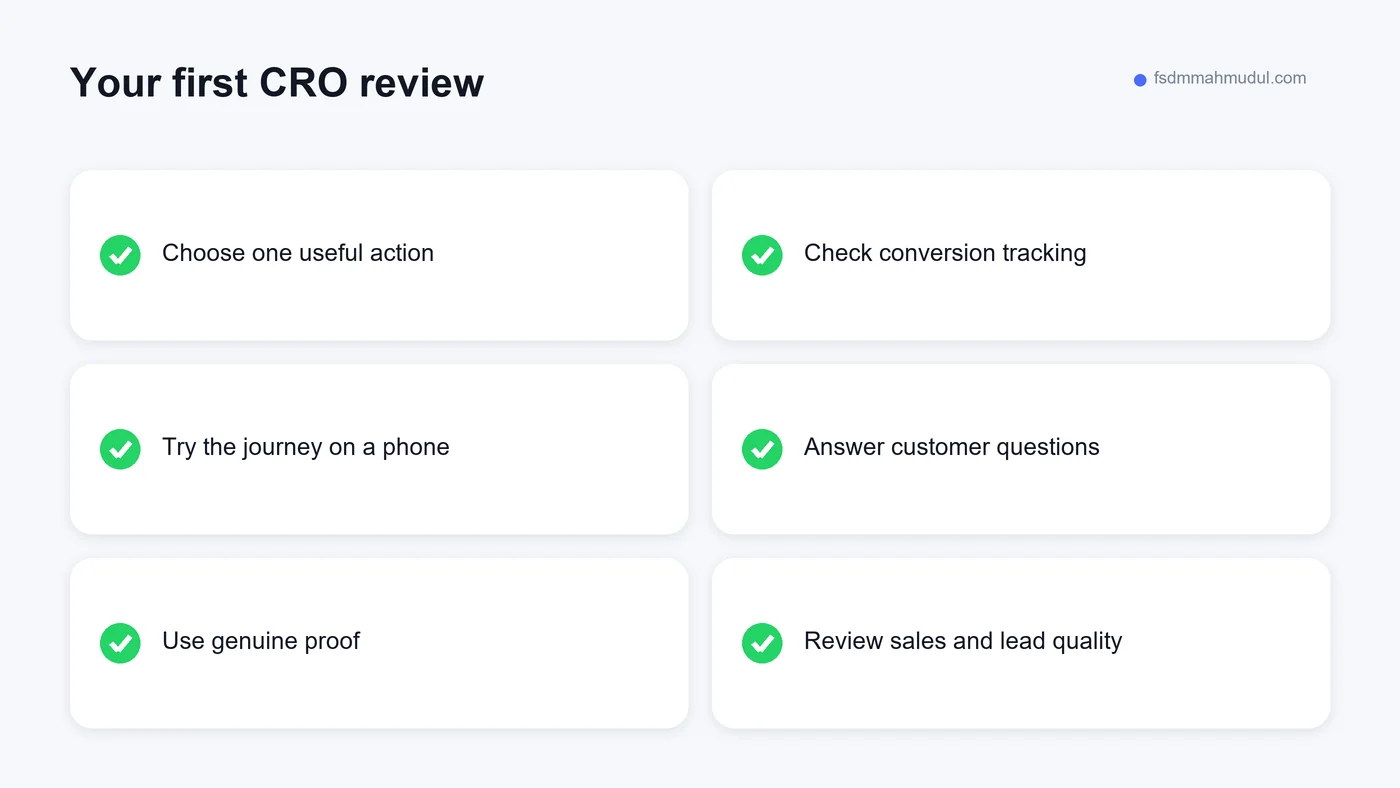
Pick a useful action, such as a completed booking enquiry. Choose a page that receives relevant visitors and leads towards that action. Write down where those visitors come from and what the page needs to help them do.
Check your tracking against actual enquiries or orders. Record the current rate, traffic source and device split. Note any campaigns or promotions that could affect the comparison later.
Use customer questions, support messages and page reports to find possible problems. Ask someone unfamiliar with the site to try the journey. Watch where they hesitate and ask what information they expected to find.
Explain the problem and the change you expect to help. For example: visitors ask whether you serve their area, so you will place accurate service-area information beside the enquiry form. This gives the change a reason that you can review.
Test the page on phones and computers before judging its results. Where traffic allows, use a properly planned comparison between the existing page and a variation. Decide the main measure and test plan before starting.
Look at lead quality, sales and costs alongside the conversion rate. Keep a record of what changed and what happened. If the evidence is uncertain, say so. A clear record makes the next review more useful.
An A/B test compares versions shown to different visitors. With low traffic, that comparison may take too long to answer a small question reliably. Fix clear technical faults and use customer feedback, while recognising that a before-and-after change does not prove cause and effect.
For a page-by-page review, use our landing page CRO checklist. It turns these principles into checks you can work through with your team.
No. Start with the evidence. A clearer explanation, a repaired form or accurate delivery information may address a specific barrier. A larger redesign needs a clear reason and careful checks.
No. The goal, audience, price and buying journey all affect the rate. Compare your own results using consistent measures, and check whether the enquiries or sales are valuable.
Yes. You can review customer questions and test whether the journey works. Low traffic can limit formal experiments, so separate useful observations from proven improvements.
There is no fixed timeline or guaranteed uplift. The answer depends on the problem, traffic and buying cycle. Check changes carefully and allow enough evidence to assess them.
Choose one important page, complete the main action yourself and list the questions a new visitor might have. Confirm that you can measure the outcome before making further changes.
For another explanation of the core concept, see Optimizely's CRO overview.
If you want our team to review the barriers between your ads and your website's enquiries or sales, Get My Free Audit.
We can review your current setup and show which issue should be addressed first.
Get My Free AuditHere are answers to the questions people ask us most. Can't find yours? Message us and we usually reply within an hour.

We review your campaigns, tracking or conversion journey, then show you the main issue limiting performance, its business impact and a practical next step.
Yes. Most clients start from $1,000 a month in ad spend. We will tell you honestly if your budget is too small.
A dedicated specialist from our team runs your account day to day, and Mahmudul oversees the strategy and reviews the results. You always have one point of contact, so you never have to chase anyone.
No. Work is month to month and you can cancel any time.
Always. Your accounts, campaigns and tracking stay yours, even if we stop working together.
Wasted spend usually drops in the first 2 weeks. Steady growth shows by month 2 or 3.
Clients in Bangladesh, the US, UK, Canada, Australia and Europe. Our team works across time zones.
Request a free audit or message us on WhatsApp. We confirm the audit is a good fit, share our findings or invite you to a review, then agree the next step with Mahmudul.
Yes. Our tracking specialist checks that every sale, lead and call is counted correctly, because good ads need good data.
Yes. We send clear, simple notes your developer can follow, or our own developer makes the changes for you.
With a team. Mahmudul leads a small group of specialists in ads, tracking, page design and website development. Each person works on what they know best, and Mahmudul checks the work before it reaches you. If someone is away, another team member covers for them, so your work never stops.
You get a simple monthly report showing what we spent, what we got back and what we will do next. Mahmudul reviews every report before it is sent.